What to Review in an Inbound-Call Record Before Handoff
Turning conversations into structured records is only the first step. Before an inbound call moves downstream, a human reviewer must confirm which fields matter, what is unresolved, and what needs clarification.
When an inbound AI phone agent answers high-volume phone traffic, the operational output is not an unstructured voicemail or an unwieldy block of text. It is a structured call record populated with caller details, intake responses, and intended next actions.
However, having data organized into key-value pairs does not automatically mean every record is ready for immediate consumption. Downstream systems and teams have differing operational tolerances. A sales representative requires verified contact details and direct business pain before dialing. An operations coordinator requires exact service locations and urgency flags before scheduling field crews. If a record contains conflicting details, missing requirements, or ambiguous context, passing it downstream unchecked creates operational friction, wasted outreach, and lost customer confidence.
To ensure captured call data creates real operational momentum, a sales or operations data owner must establish an explicit human review step before downstream handoff:
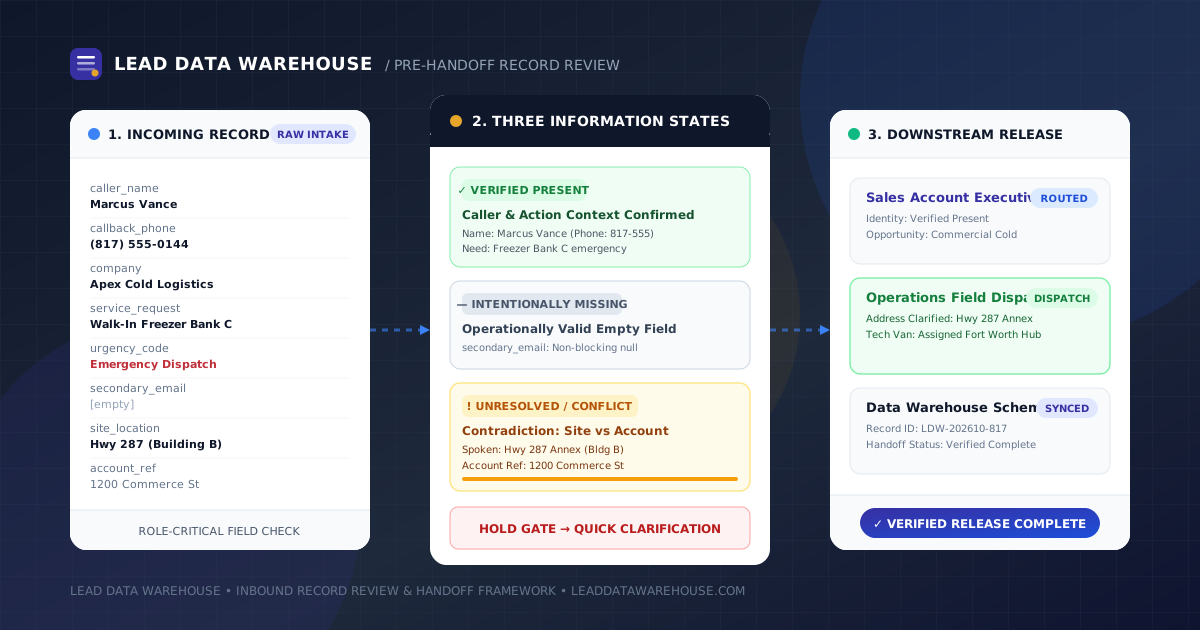
Before releasing a structured inbound-call record to downstream systems or teams, a data owner must evaluate role-critical fields, categorize data into three distinct information states (Verified Present, Intentionally Missing, or Unresolved/Conflicting), and resolve blocking ambiguities before handoff.
Here is a systematic framework for conducting that human review, categorizing field health, and establishing clear handoff gates.
1. Identify which fields matter to the next owner
A common mistake in data operations is treating every field in an intake schema with equal importance. When a reviewer attempts to verify every data point with equal intensity, review queues backlog, slowing response times on urgent opportunities. Conversely, ignoring field priorities leads to passing incomplete records that frontline teams cannot action.
Effective pre-handoff review requires understanding the specific operational mandate of the receiving team. Different downstream owners require different baseline context:
The Sales Owner (Account Executive / Inside Sales)
When an inbound record routes to a sales team, the owner's goal is to conduct an intelligent, context-aware discovery call or demonstration.
- Essential Action-Driving Fields: Verified callback phone number, direct contact name, business or organization name, primary pain point or requested solution, and timing/budget qualification indicators.
- Secondary Context: General background notes, secondary email address, referral source, or optional caller preferences.
- Handoff Test: If the rep picks up the phone, do they know who they are speaking with, how to reach them, and exactly what problem prompted the inbound call?
The Operations Owner (Field Dispatch / Service Delivery)
When an inbound record routes to operations or technical dispatch, the owner's goal is to evaluate service capability, schedule resources, and confirm logistics.
- Essential Action-Driving Fields: Exact service or property address, specific equipment model or service scope, stated urgency or operational impact, and on-site access contact.
- Secondary Context: Historical vendor notes, billing preference details, or general company website links.
- Handoff Test: Can dispatch assign a technician or crew without guessing where the job is located or what equipment needs attention?
The Analytics or Database Destination
When a record routes into an operational data warehouse or reporting repository, consistency of structure takes priority over immediate outreach.
- Essential Action-Driving Fields: Unique record identifier, call timestamp, intake flow version, standardized category classification, and completed handoff status.
- Secondary Context: Extended conversational notes or unmapped open-ended remarks.
- Handoff Test: Are standardized categorical fields formatted to match warehouse schema expectations without corrupted data types?
As established in our guide on how to keep inbound call fields consistent across teams, every field must earn its place by informing a concrete decision. By focusing review on the receiving owner's essential action-driving fields, the reviewer ensures high-priority records move fast without sacrificing operational integrity.
2. The three-state framework: Distinguish present, missing, and unresolved information
In many organizations, record quality is assessed on a blunt binary scale: "complete" or "incomplete." This binary view is flawed. In real inbound operations, a field that was intentionally skipped is completely different from a field that contains contradictory or garbled data.
A systematic reviewer evaluates each critical field against three mutually distinct information states:
| Information State | Operational Definition |
|---|---|
| State 1: Verified Present | Value captured clearly and confirmed by caller. |
| State 2: Intentionally Missing | Value not provided or not applicable (valid). |
| State 3: Unresolved / Conflicting | Contradictory, corrupted, or ambiguous data. |
State 1: Verified Present
A field is Verified Present when the captured information is unambiguous, matches expected formatting, and was directly affirmed by the caller during the intake conversation.
- Example: Callback number captured as a standard 10-digit number and confirmed by the caller during intake; organization name provided clearly without audio ambiguity.
- Reviewer Action: Mark as verified; proceed to handoff.
State 2: Intentionally Missing
A field is Intentionally Missing when no data was entered, but the absence of data is operationally valid. This occurs when a caller chooses not to provide non-mandatory details, when an intake branch intentionally skips questions that do not apply to the caller's situation, or when an optional secondary contact is absent.
- Example: A caller requests an initial service estimate but declines to provide a target budget; an emergency dispatch caller does not have an alternative contact email.
- Reviewer Action: Verify whether the field is strictly mandatory for the next owner. If the missing field is secondary context, mark as a valid null value and proceed. If the missing field is mandatory for downstream execution, flag it for owner decision rather than assuming it is broken.
State 3: Unresolved or Conflicting
A field is Unresolved or Conflicting when information was captured, but the value is internally contradictory, garbled, incomplete, or impossible to interpret with certainty.
- Example: The caller stated an address in Dallas, but the caller ID and area code correspond to an out-of-state number and the spoken street name matches two different regional hubs; the caller indicated an urgent equipment failure requiring same-day repair, but later stated they cannot meet a technician until next Tuesday.
- Reviewer Action: Halt handoff. This state represents active operational risk. Passing an unresolved field downstream forces the receiving sales rep or dispatcher to untangle the contradiction in front of the customer or sends field personnel to the wrong destination.
3. What must be clarified before the record is used
Once fields are evaluated against the three-state framework, the reviewer must make a handoff gating decision: Release, Clarify, or Reroute.
To make this decision repeatable, apply three explicit gating criteria:
Criterion 1: Outreach and Identity Viability
Before handing a record to any person or system, can the receiving owner reliably identify and re-engage the caller?
- Review Check: Is the primary callback number or email verified present? If the callback number is cut off, malformed, or missing, the record cannot be handed off for active sales or dispatch follow-up.
- Resolution: If the contact number is unresolved, inspect the system-level caller ID or call logs. If identity cannot be established, route the record to an exception review queue rather than polluting active pipeline stages.
Criterion 2: Destination and Ownership Clarity
Does the record clearly indicate which department, service line, or geographical territory owns the follow-up?
- Review Check: Does the captured intent match the designated destination? For instance, if an inbound caller requested routine warranty billing but was initially categorized as a new commercial sales inquiry, handing off the record to sales creates friction.
- Resolution: Reclassify the routing destination based on the captured intent before delivering the record to downstream queues.
Criterion 3: Core Requirement Consistency
Does the record present a coherent customer situation that the receiving team can act on without immediate confusion?
- Review Check: Are critical action-driving fields free of unresolved contradictions? If a prospective client indicated they need enterprise data integrations but also stated they have no technical staff and need a turnkey phone answering service, the context is contradictory.
- Resolution: A reviewer should add an explicit review note summarizing the ambiguity, allowing the receiving sales representative or solutions specialist to approach the discovery call with full awareness of the caller's mixed signals.
As outlined in an inbound call-record checklist for operations teams, making the exception state explicit protects downstream teams. It is far better to hold a record for two minutes of human verification than to trigger an automated workflow based on conflicting inputs.
4. The manual review grid: A blank evaluation template
To implement structured review across your team without relying on unverified software connectors or custom coding, data owners can use a standardized manual review grid.
This template allows an operations reviewer to systematically audit structured call records prior to CRM ingestion, field dispatch, or sales assignment:
| Field Name | Receiving Owner / Purpose | Evaluated State | Observed Value / Reviewer Notes | Downstream Gate |
|---|---|---|---|---|
caller_name |
Sales / Dispatch (Identity) | [ ] Present [ ] Missing [ ] Unresolved |
[ ] Proceed [ ] Hold [ ] Clarify |
|
organization_name |
Sales / Account Team (Fit) | [ ] Present [ ] Missing [ ] Unresolved |
[ ] Proceed [ ] Hold [ ] Clarify |
|
callback_phone |
All Owners (Outreach Viability) | [ ] Present [ ] Missing [ ] Unresolved |
[ ] Proceed [ ] Hold [ ] Clarify |
|
caller_intent_category |
Routing / Triage (Destination) | [ ] Present [ ] Missing [ ] Unresolved |
[ ] Proceed [ ] Hold [ ] Clarify |
|
primary_requirement |
Sales / Service (Action Context) | [ ] Present [ ] Missing [ ] Unresolved |
[ ] Proceed [ ] Hold [ ] Clarify |
|
urgency_or_timeline |
Operations (Priority / SLA) | [ ] Present [ ] Missing [ ] Unresolved |
[ ] Proceed [ ] Hold [ ] Clarify |
|
location_or_address |
Dispatch / Territory (Logistics) | [ ] Present [ ] Missing [ ] Unresolved |
[ ] Proceed [ ] Hold [ ] Clarify |
|
secondary_contact |
Operations / Account (Optional) | [ ] Present [ ] Missing [ ] Unresolved |
[ ] Proceed [ ] Hold [ ] Clarify |
|
exception_or_risk_flag |
Data Owner / Compliance (Integrity) | [ ] Present [ ] Missing [ ] Unresolved |
[ ] Proceed [ ] Hold [ ] Clarify |
How to use this grid
- 1. Map incoming structured values into the corresponding field rows.
- 2. Assign the evaluation state using the three-state definitions. Do not mark an empty field as "Unresolved" if it is merely optional context.
- 3. Record reviewer notes on any discrepancies or specific caller phrasing that the next owner must see.
- 4. Determine the gate outcome:
- Proceed: All essential action-driving fields are Verified Present or validly Missing. Handoff occurs immediately.
- Hold: A critical blocker exists (e.g., malformed callback number or unverified location). Record is quarantined until clarified.
- Clarify: Minor ambiguity exists that does not prevent handoff, but requires an attached reviewer flag for the receiving rep.
5. An illustrative scenario: Evaluating an equipment service intake
Illustrative Example
This scenario is an illustrative operational example designed to show record review and field classification; it does not represent an actual customer endorsement, proprietary integration, or verified performance outcome.
Consider a regional commercial refrigeration and HVAC equipment service provider that handles dozens of inbound maintenance calls daily. Their inbound AI phone agent captures incoming conversations into structured fields for their central dispatch and commercial sales teams.
The Incoming Record
An inbound call concludes, generating the following captured data record:
- Caller Name: "Marcus Vance"
- Company: "Apex Cold Logistics"
- Callback Number:
(817) 555-0144 - Service Request: "Compressor failure on Walk-In Freezer Bank C; temperatures climbing above safe threshold."
- Urgency Code: "Immediate / Emergency Dispatch"
- Secondary Contact Email: [empty]
- Site Location: "Our Fort Worth distribution center on Highway 287 (Building B)"
- Existing Account Reference: "Apex Logistics - Main Depot, 1200 Commerce St, Fort Worth"
The Reviewer's Evaluation
A dispatch data coordinator opens the record and conducts a 60-second evaluation using the manual review grid:
- 1. Outreach & Identity:
caller_nameandcallback_phoneare Verified Present. The area code matches the Fort Worth territory, and the phone number is verified. - 2. Action Context & Urgency:
service_requestandurgency_codeare Verified Present. The situation is clearly high-priority commercial refrigeration failure requiring immediate field dispatch. - 3. Secondary Contact:
secondary_contact_emailis Intentionally Missing. For an emergency refrigeration dispatch call, a secondary email is non-essential. It does not block handoff. - 4. Location & Logistics:
site_locationis Unresolved / Conflicting. The caller specifically stated "Highway 287 (Building B)," but their historical account in the depot records lists "1200 Commerce St."
The Reviewer's Gating Decision
If this record were automatically pushed to field technicians without human review, a service van could easily navigate to the historical Commerce Street facility while inventory spoils at the Highway 287 facility.
- Decision: The reviewer sets the gate to Hold for Clarification.
- Action: The reviewer immediately sends a quick one-touch confirmation text or calls Marcus directly at
(817) 555-0144: "Marcus, confirming your emergency service location: should technicians report to your Highway 287 facility or Commerce Street?" Marcus confirms Highway 287 is their new cold-storage annex. - Resolution: The reviewer updates
site_locationto "Verified: Hwy 287 Annex (Bldg B)", appends an account note to update the master record, changes the gate to Proceed, and releases the record directly to the on-call Fort Worth field technician.
Total review time: 90 seconds. Total downtime and misrouted truck rolls prevented: substantial.
6. How Lead Data Warehouse turns inbound calls into structured records
At Lead Data Warehouse, our platform is built for businesses that cannot afford to let high-volume phone traffic dissipate into lost messages or disconnected notes. We provide an inbound AI phone agent that answers incoming callers 24/7, qualifies callers against your specific operational questions, and captures every conversation as a clean, structured record designed for downstream CRM, warehouse, and dispatch use.
Sales-assisted initial setup and customer control
Designing an effective call capture and handoff flow does not require complex engineering overhead:
- Sales-assisted initial setup: Our team works directly with your sales and operations leadership to define your initial intake logic, approved questions, required fields, and downstream routing rules.
- Customer control in the platform: Once your initial flow is live, you can modify call handling, update qualification questions, and refine field expectations directly in the platform, with support available for additional assistance.
Transparent, predictable commercial terms
We believe structured telephony operations should operate on clear, straightforward commercial terms:
- Standard subscription: The standard AI Phone Agent subscription is $199 per month, billed month to month.
- Zero upfront fees: There is no setup or onboarding fee ($0).
- Included monthly allowances: Each monthly billing period includes 500 inbound voice minutes and 500 SMS text messages.
- Affordable metered overages: Usage beyond monthly allowances is billed at $0.12 per additional minute and $0.02 per additional SMS.
- Month-to-month flexibility: Cancel before the end of your current billing period to prevent renewal for the next cycle. Phone service remains available through the paid period; overage charges already incurred remain due. Refunds for prepaid monthly service are considered case by case.
Build reliable downstream handoffs today
Structured inbound data is only as valuable as the decisions it enables. Pair clean field capture with systematic human review to ensure every conversation drives verified downstream action.
- Ready to establish your intake workflow? Map your call record with our team or start phone service directly.
- Learn more about our process: Read How Lead Data Warehouse Works and check our Data-First Call FAQ.
- Master field design: Read A useful inbound call record starts with the fields.
- Standardize cross-team definitions: Review How to keep inbound call fields consistent across teams.
- Check operational readiness: Consult An inbound call-record checklist for operations teams.
- Review our terms: Read the complete Lead Data Warehouse Terms of Service.