Field-Mapping Handoff Questions: Who Approves the Schema?
Capturing structured data is only half the battle. Without clear sign-off on who owns field definitions and how changes are managed, downstream teams will interpret the same call in conflicting ways.
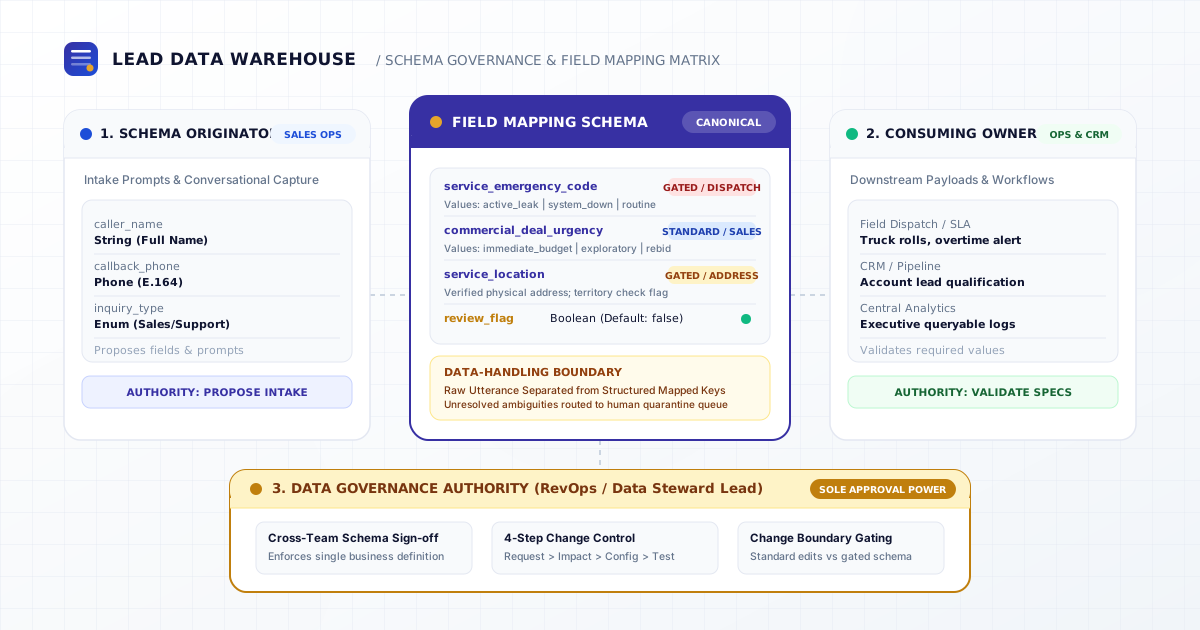
When an organization deploys an inbound AI phone agent to translate live telephone conversations into structured records, capturing data is only the initial hurdle. High-volume teams quickly discover that the hardest challenge is not recording details—it is governing how those details are interpreted across the business.
A single inbound call often feeds multiple departments. Inside sales needs caller intent and qualification criteria to prioritize follow-up. Field operations requires exact physical addresses, equipment identifiers, and urgency flags to dispatch technicians. Marketing requires campaign attribution and demographic signals to measure acquisition channels. Meanwhile, central analytics requires standardized categories and clean data types to produce accurate executive reporting.
When any of these teams alters a field definition unilaterally—or when nobody clearly owns the schema—the data pipeline fractures:
- A sales manager adds an “urgent” tag to prioritize high-budget sales inquiries, inadvertently triggering emergency after-hours dispatch alerts for non-critical calls.
- Operations renames a status category in a downstream tool, causing incoming records mapped to the old label to fail ingestion or drop silently into an unmonitored queue.
- Marketing introduces five new qualification questions into the intake script, extending call handling times without confirming whether sales reps actually review those fields.
To prevent cross-departmental friction and data corruption, a sales operations or data governance leader must answer three foundational questions before and during production:
The Field Mapping Governance Rule:
A reliable inbound call data pipeline requires a designated governance owner who approves the field mapping schema, an explicit change-management protocol for downstream field modifications, and strict data-handling boundaries between raw conversational intake and downstream operational payloads.
Here is a practical framework for establishing who approves your field map, how to manage downstream changes, and how to protect data-handling boundaries across departments.
1. Establishing schema authority: Who signs off on the field map?
In many organizations, field maps emerge haphazardly. An individual configuring an answering service types in arbitrary field names based on whatever seems useful in the moment. Over time, fields proliferate without documentation, leading to duplicate attributes, conflicting definitions, and unowned data.
To maintain schema integrity, organizations must define three distinct governance roles for every field in the call record:
| Role | Operational Responsibility | Authority Level |
|---|---|---|
| 1. Schema Originator (e.g., Sales Ops) |
Defines intake questions & captures caller responses from live calls. | Proposes fields & questions; cannot alter downstream keys. |
| 2. Consuming Owner (e.g., Ops / Dispatch) |
Consumes the structured field to drive downstream action (CRM, dispatch). | Validates field usefulness; defines acceptable values. |
| 3. Governance Authority (Data / RevOps Lead) |
Reconciles cross-team definitions and enforces global schema consistency. | Holds sole approval power to add, alter, or retire fields. |
Role 1: The Schema Originator (The Intake Designer)
The Schema Originator—typically a Sales Operations or Customer Service lead—determines what questions the AI phone agent asks callers during intake. They understand the conversational flow and identify the raw details needed from the caller. However, the Originator does not possess unilateral authority to map those details to new downstream database fields without stakeholder review.
Role 2: The Consuming Owner (The Downstream Operator)
The Consuming Owner is the person or department that directly uses the mapped field to execute work. For example, a dispatch supervisor consumes service_location and urgency_level to schedule a truck roll; an account executive consumes budget_range and decision_timeline to prepare a proposal. The Consuming Owner defines the operational requirements: What format must this value take? What constitutes an acceptable answer? What should happen if this value is missing?
Role 3: The Governance Authority (The Schema Gatekeeper)
The Governance Authority—typically a Revenue Operations Director, Lead Operations Manager, or Data Steward—holds the sole sign-off authority for approving new field mappings, modifying existing schema definitions, or retiring obsolete fields. The Governance Authority ensures that:
- Every field has a single, unambiguous definition shared across all teams.
- New fields do not duplicate existing attributes under different naming conventions.
- Changes requested by one department do not disrupt downstream integrations or reporting models relied upon by another department.
As outlined in our guide on how to keep inbound call fields consistent across teams, every field must earn its place by informing a concrete decision. By designating a single Governance Authority to approve the schema, you prevent uncoordinated additions from muddying your operational data.
2. Managing downstream changes: A change-control protocol
Once an initial field map is established, business needs will inevitably evolve. A sales team might expand into a new territory, an operations team might refine its service categories, or a marketing team might launch a specialized promotional campaign.
When downstream field requirements change, organizations must distinguish between routine operational tweaks that can be handled quickly and gated schema modifications that require formal review.
Routine in-platform edits (Non-gated)
Under standard operating procedures, certain operational adjustments do not alter the underlying data schema or impact downstream integrations. These can be adjusted directly in the platform:
- Operating schedule updates: Modifying daytime answering hours or holiday handling rules.
- Notification destination changes: Updating the email address or phone number receiving call summary alerts.
- Conversational prompt refinements: Polishing the conversational phrasing an AI agent uses to ask a question, provided the underlying data type and meaning of the captured field remain identical.
- Staff transfer destinations: Updating internal telephone extensions or forward-to numbers for live escalations.
Gated schema modifications (Requires sign-off)
Any change that alters the structure, format, or business meaning of captured data must pass through formal schema review before being deployed to the live phone flow. Gated changes include:
- Adding a new required field: Introducing a new question that callers must answer before a record is completed. This impacts call completion rates and requires downstream systems to have an accommodating destination field ready.
- Altering permitted values (Enum changes): Adding, modifying, or removing acceptable category values (e.g., changing
job_typefrom["residential", "commercial"]to["residential", "commercial", "industrial"]). Downstream routing rules and CRM picklists must be updated simultaneously to prevent unmapped record errors. - Redefining existing field semantics: Changing the operational meaning of a field without changing its name. If
urgency_codepreviously meant “caller requested same-day callback” and is redefined to mean “active physical property emergency,” any team acting on historical assumptions will make severe operational mistakes. - Field deprecation or retirement: Removing a field from the active intake flow. The Governance Authority must confirm that no automated downstream workflows, reporting dashboards, or operational teams depend on that field before it is decommissioned.
The 4-step change review workflow
To implement a gated change smoothly:
- Submit Request: The requesting team documents the proposed change, the business rationale, and the affected downstream workflows.
- Impact Assessment: The Governance Authority reviews the change against all consuming endpoints (sales pipelines, dispatch queues, reporting views).
- Coordinated Configuration: The field mapping is updated in the platform, and receiving fields/picklists are created or updated in downstream destination systems in parallel.
- Validation Test: A test call is executed through the updated phone flow to verify that the captured value maps accurately into the downstream destination before opening the flow to live callers.
3. Establishing data-handling boundaries across departments
Capturing structured data from live speech requires clear boundaries. Spoken conversations are dynamic and unpredictable, whereas downstream databases require rigid types and validated syntax. Without explicit data-handling boundaries, errors compound quickly.
To maintain system stability, enforce three operational boundaries:
Boundary 1: Separate raw spoken utterance from structured mapped value
Never pass raw, unvalidated conversational text directly into a rigid downstream operational field.
- The Spoken Input: A caller might say, “Well, we're having a complete disaster with our rooftop chiller—it's leaking glycol all over the roof deck and we need someone here right now.”
- The Structured Record: The system extracts and maps specific key-values:
equipment_type:"chiller"issue_category:"leak_glycol"urgency_level:"emergency_dispatch"
- The Operational Boundary: The structured fields drive downstream automated routing and dispatch scheduling, while the full conversational context is preserved in a separate notes or summary field for human review. If an automated mapping confidence is low, the record must be flagged for human verification rather than guessed.
Boundary 2: Delineate intake qualification from transactional execution
A phone agent's role is intake capture and preliminary qualification—it is not an automated transactional ERP or live inventory engine.
- An intake agent can verify whether a caller's stated service address falls within your operational service territory.
- It should not attempt to commit live dispatch schedules or promise binding inventory availability unless an explicit, verified human handoff or validated dispatch protocol is established.
- Maintaining this boundary ensures that customer-facing promises align with real operational capacities.
Boundary 3: Isolate exception states in a quarantine queue
Not every call fits the standard schema. A caller may speak a dialect or language outside standard patterns, describe a complex multi-part request, or refuse to provide required screening details.
- As established in an inbound call-record checklist for operations teams, the intake schema must include an explicit
exception_stateorreview_statusflag. - If a record contains conflicting, garbled, or missing critical fields, it must route to a designated human review queue—as described in what to review in an inbound-call record before handoff—rather than being pushed downstream to fail silently.
Operational Guardrail: Lead Data Warehouse enables structured capture and clean field mapping for downstream delivery. We do not claim automated live database syncing, SQL data warehouse connectors, real-time schema migrations, or data retention/security certifications. System integrations and data-handling boundaries are configured around your team's specific destination endpoints and operational review policies.
4. The blank illustrative field-mapping approval worksheet
To help operations and governance teams establish clear field ownership and manage downstream changes, use this standardized approval worksheet.
Before deploying any new inbound phone flow or altering existing field mappings, complete this worksheet with your cross-functional stakeholders:
| Field Key / Name | Business Purpose | Schema Owner | Consuming Team & System | Data Type & Permitted Values | Change Review Level | Exception / Fallback Rule |
|---|---|---|---|---|---|---|
caller_name |
Primary caller identity | Sales Ops | CRM (Sales) / Dispatch (Ops) | String (First, Last) | Gated | Flag as “Unverified Caller” if missing; route to review |
callback_phone |
Return contact channel | Sales Ops | All downstream systems | Phone (E.164 formatted) | Gated | Fall back to inbound Caller ID; flag if unconfirmed |
organization_name |
Business entity identity | Sales Ops | CRM (Account Object) | String (Free text) | Standard | Mark as “Residential / Individual” if not a business |
inquiry_type |
High-level triage category | Governance | Triage Queue / Dispatch | Enum (sales, support, dispatch, billing) |
Gated | Default to general_triage if ambiguous |
urgency_rating |
Prioritization & SLA tier | Ops / Dispatch | Field Dispatch / On-Call Queue | Enum (critical_emergency, standard_schedule, info_only) |
Gated | Require human review before dispatching emergency crews |
service_location |
Physical job address | Ops / Dispatch | Dispatch / Logistics Tool | String (Street, City, State, ZIP) | Gated | Flag as “Territory Check Required” if outside service area |
budget_indication |
Commercial qualification | Sales Ops | CRM (Opportunity Record) | Enum (under_5k, 5k_to_25k, over_25k, undisclosed) |
Standard | Mark undisclosed if caller declines; do not halt call |
notes_summary |
Conversational context | Governance | All downstream teams | String (Structured summary text) | Standard | Always populate with core caller statements |
review_flag |
Data integrity & gating | Governance | Ops Review Queue | Boolean (true, false) |
Gated | Automatically set to true if any mandatory field is missing |
How to use this worksheet
- Inventory every candidate field: List every data point your team wishes to collect during inbound calls. If a field does not directly drive a downstream decision, eliminate it.
- Assign a single Schema Owner: Designate the specific person or role responsible for the business definition of that field.
- Identify all Consuming Teams & Systems: Document every tool and department that will receive this field value.
- Lock Data Types & Permitted Values: Define strict constraints (e.g., standard phone format, exact enum picklist values) rather than allowing unconstrained free-form entry.
- Establish Change Review Level: Mark fields as Standard (internal operational tweaks) or Gated (schema changes requiring Governance Authority approval).
- Define the Exception Fallback: Specify exactly what happens when a caller skips the question or provides conflicting information.
5. An illustrative scenario: Catching an urgency definition collision
Illustrative Example
This scenario is an illustrative operational example designed to show schema approval and change governance; it does not represent an actual customer endorsement, proprietary integration, or verified performance outcome.
Consider a regional commercial mechanical services firm providing HVAC, refrigeration, and plumbing solutions to commercial facilities. Their inbound AI phone agent captures incoming service requests and routes them to two downstream departments: the Inside Sales team (handling new equipment installations and service contracts) and the Field Dispatch team (handling emergency service and preventive maintenance).
The Proposed Schema Change
During a quarterly planning session, the Inside Sales Manager submitted a request to add a new mandatory field to the intake flow: priority_level with allowed values of ["High", "Medium", "Standard"].
The Sales Manager's objective was straightforward: when a high-value prospective client calls wanting a bid on a $100,000 chiller installation, the sales agent should capture priority_level: "High" so that account executives follow up within two hours.
The Governance Review
Before deploying the change, the company's Revenue Operations Lead—acting as the designated Governance Authority—ran the proposal through the Field-Mapping Approval Worksheet and held a joint review with the Field Dispatch Supervisor.
During the review, the Dispatch Supervisor identified an immediate operational collision:
- In Field Dispatch, the term “High Priority” triggers an automated on-call SMS alert to master technicians, authorizing emergency truck rolls and after-hours overtime rates.
- If a caller seeking a quote on a commercial replacement was categorized as
priority_level: "High", the dispatch system would interpret the record as an active physical facility catastrophe, waking up technicians for a non-urgent sales inquiry. - Conversely, if the caller had an active boiler explosion, sales reps might view the record as a standard lead opportunity rather than an immediate safety hazard.
The Resolution
Because the company enforced a formal schema approval process, the conflict was resolved before a single live call was affected:
- Schema Separation: Instead of a single ambiguous
priority_levelfield, the Governance Authority created two distinct, tightly scoped fields:service_emergency_code: Owned by Field Dispatch. Allowed values:["active_leak_hazard", "system_down_spoilage", "routine_service"]. Onlysystem_down_spoilageandactive_leak_hazardtrigger emergency dispatch workflows.commercial_deal_urgency: Owned by Inside Sales. Allowed values:["immediate_budget_cycle", "exploratory_planning", "rebid"]. Drives sales pipeline prioritization without touching dispatch queues.
- Clear Handoff Gates: Intake logic was configured so that any call indicating physical property hazard immediately sets
service_emergency_codeand routes to dispatch, while new equipment inquiries route exclusively to sales. - Worksheet Sign-off: Both department heads signed off on the revised definitions and exception rules before the updated phone flow went live.
Total time invested in schema review: 30 minutes. Operational friction, misrouted technician trucks, and confused customers prevented: immeasurable.
6. How Lead Data Warehouse turns inbound calls into structured records
At Lead Data Warehouse, our platform is built for businesses that handle high call volume and cannot afford to let telephone interactions vanish into chaotic voicemail boxes or unorganized notes. We provide an inbound AI phone agent that answers callers 24/7, qualifies them against your custom operational criteria, and captures every interaction as a structured, consistent record designed for downstream CRM, warehouse, and operational use.
Sales-assisted initial setup and customer control
Designing an effective call intake flow and field mapping schema does not require dedicated software engineers:
- Sales-assisted initial setup: Our team collaborates directly with your sales and operations leadership during onboarding to configure your initial call flow, draft intake questions, establish field definitions, and align downstream routing rules.
- Customer control in the platform: Once your phone agent is active, you can modify operating schedules, update FAQ answers, and adjust notification preferences directly in the platform, with support available for additional assistance whenever structural changes are needed.
Transparent, predictable commercial terms
We provide reliable telephony infrastructure with clear, predictable pricing:
- Standard subscription: The standard AI Phone Agent subscription is $199 per month, billed month to month.
- Zero upfront fees: There is no setup or onboarding fee ($0).
- Included monthly allowances: Each monthly billing period includes 500 inbound voice minutes and 500 SMS text messages.
- Affordable metered overages: Usage beyond monthly allowances is billed at $0.12 per additional minute and $0.02 per additional SMS.
- Flexible month-to-month commitment: Cancel before the end of your current billing period to prevent renewal for the next cycle. Phone service remains available through the paid period; overage charges already incurred remain due. Refunds for prepaid monthly service are considered case by case.
Build reliable downstream data handoffs today
A structured inbound call record is only as valuable as the cross-departmental clarity behind it. Pair rigorous field capture with explicit schema governance to ensure every call moves your business forward.
- Ready to configure your intake schema? Talk through your field map with our team or start phone service directly.
- Learn more about our process: Read How Lead Data Warehouse Works and check our Data-First Call FAQ.
- Standardize cross-team definitions: Review How to keep inbound call fields consistent across teams.
- Master pre-handoff evaluation: Read What to review in an inbound-call record before handoff.
- Check operational readiness: Consult An inbound call-record checklist for operations teams.
- Review our terms: Read the complete Lead Data Warehouse Terms of Service.